Health Assessment - GAIT, Mobility & Physical Function
GAIT, Mobility & Physical Function
The gait, mobility, and physical function domain in TILDA comprises objective performance-based assessments designed to evaluate locomotion, balance, muscle strength, and functional capacity in older adults. Measures collected across waves include gait speed, walking characteristics, chair stands, grip strength, and other standardised tests of physical performance, providing information on mobility, functional independence, musculoskeletal health, and physical capability.
GAIT, Mobility & Physical Function Measures
Click each heading to expand details of this test.
Overview
Measuring: Temporal and spatial gait parameters as part of the Health Assessment.
Equipment used: GAITRite™ [CIR Systems Inc., NJ, USA]
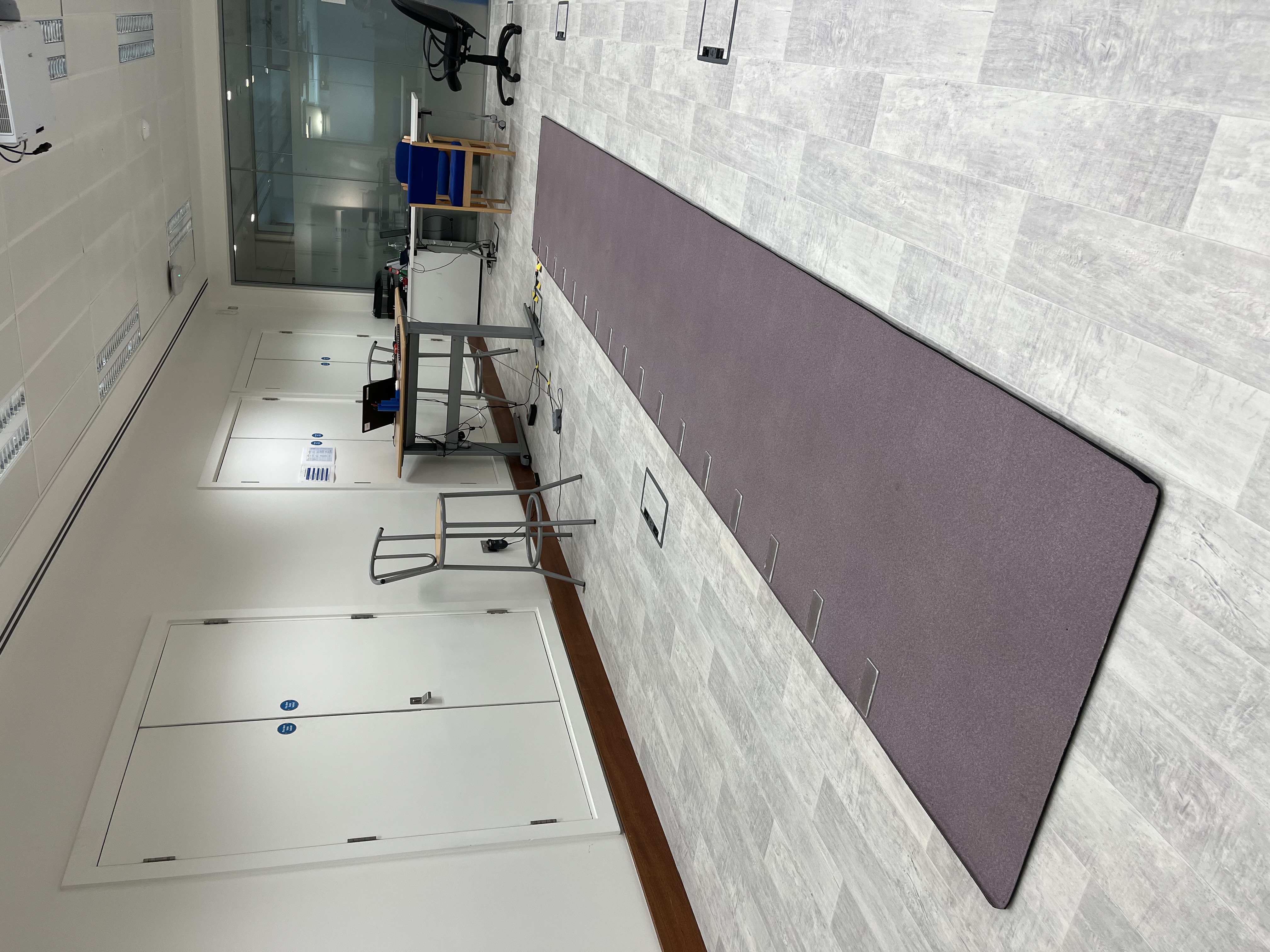
Equipment Description: Portable single layer pressure sensitive walkway measuring temporal and spatial parameters and providing easy identification of gait anomalies.
Assessment Type: Centre Assessment Only
Protocol
- The walking tasks began 2.5 meters before the start of the mat and continued for 2 meters at the end of the mat to facilitate acceleration, deceleration and turning.
- Participants completed 3 walks in all waves and had 2 trials for every walk.
- All walks carried out while completing the walks are outlined below.
Collection Waves
| Walk | Walk Description | Wave 1 | Wave 3 | Wave 6 |
|---|---|---|---|---|
| Regular Walking Speed | Participants are asked to walk along the GAITRite™ mat at their normal walking speed. | X | X | X |
| Maximum Walking Speed | Participants are asked to walk along the GAITRite™ mat at their fastest pace. | X | X | |
| Dual Cognitive Walk* | Participants are asked to walk along the GAITRite™ mat while reciting alternate letters of the alphabet. | X | X | X |
| Dual Motor Walk | Participants are asked to walk along the GAITRite™ mat while carrying a glass filled to one inch from the top with water. | X |
* Participants were allowed a practice trial in which they recited alternate letters of the alphabet in a seated position prior to the dual-task walking condition.*
Citation
- McDonough, A. L., Batavia, M., Chen, F. C., Kwon, S., & Ziai, J. (2001). The validity and reliability of the GAITRite system’s measurements: A preliminary evaluation. Archives of physical medicine and rehabilitation, 82(3), 419-425.
Example TILDA Papers
- Donoghue, O., & Kenny, R. A. (2015). Amber Cross Code: Walking Speed in Middle-Aged and Older Irish Adults and the Implications for Pedestrian Traffic Signals. doi:10.38018/tildare.2015-01
- Killane, I., Donoghue, O. A., Savva, G. M., Cronin, H., Kenny, R. A., & Reilly, R. B. (2013). Variance between walking speed and neuropsychological test scores during three gait tasks across the Irish Longitudinal study on Aging (TiLDA) dataset. Annual International Conference of the IEEE Engineering in Medicine and Biology Society. IEEE Engineering in Medicine and Biology Society. Annual International Conference, 2013, 6921–6924. https://doi.org/10.1109/EMBC.2013.6611149
Overview
Measuring: Hand and upper limb functioning.
Equipment used: Baseline Hydraulic hand dynamometer
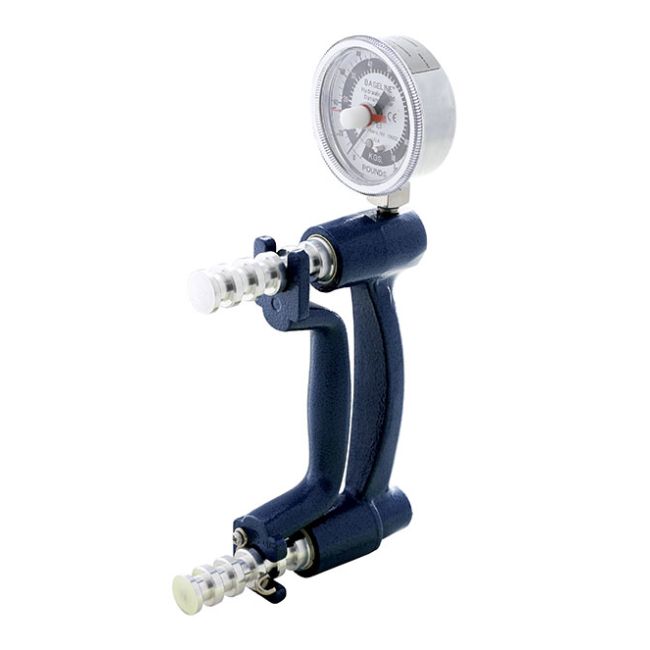
Equipment Description: Baseline Hydraulic hand dynamometer gives accurate grip strength readings without the participant being able to feel the handle move.
Assessment Type: Centre, Home Assessment, or Face to Face Interview
Protocol
- Infection control measures (sanitise hands of interviewer/nurse and participant and wipe down dynamometer) and equipment maintenance checks (cracks, damages, and leaks checks and 2 self-tests performed by interviewer/nurse) are performed before the test commences.
- Interviewer/nurse demonstrates correct technique of the test for the participant.
- Participants are asked if they were willing to have their grip strength measured and, if yes, which hand is their dominant hand.
- Exclusion criteria for the test includes; if participants have any swelling, severe pain or inflammation in their hand/wrist, if they have had recent injury, or any surgery to their hand/wrist in the past 6 months.
- The interviewer/nurse ensures a comfortable and correct grip. The metal bar should rest on the middle piece of the four fingers.
- The dial is faced outwards (away from the participant).
- Upper arm is kept tight against the participants waist and the elbow at a right angle.
- Respondent should stand for test unless unable.
- Interviewer/nurse checks with the participant if the grip is comfortable and support is provided if participant find the dynamometer too heavy.
- When ready, the max indicator (red arrow) is re-set to 0.
- When indicated, the participant is asked to squeeze as hard as they can for a few seconds.
Collection Waves
| Assessment | Wave 1 | Wave 2 | Wave 3 | Wave 4 | Wave 5 | Wave 6 |
|---|---|---|---|---|---|---|
| Two grip strength measures on the dominant and non-dominant hand* | X | X | X | |||
| Two grip strength measures on the dominant hand (or non-dominant hand if exclusion criteria were met for the dominant hand)** | X | X | X |
* Health assessment measurement conducted by a research nurse.
** CAPI interview measurement conducted by a social interviewer.
Note: Due to a calibration issue detected after the completion of Wave 5 data collection, grip strength measurements collected in Wave 5 are not included in the dataset. Researchers who wish to access the Wave 5 grip strength data should contact the Data Team.
Citation
- Hamilton, G. F., McDonald, C., & Chenier, T. C. (1992). Measurement of grip strength: validity and reliability of the sphygmomanometer and jamar grip dynamometer. The Journal of orthopaedic and sports physical therapy, 16(5), 215–219. https://doi.org/10.2519/jospt.1992.16.5.215
Example TILDA Papers
- Nolan, H., O’Connor, J. D., Donoghue, O. A., Savva, G. M., O’Leary, N., & Kenny, R. A. (2020). Factors affecting reliability of grip strength measurements in middle aged and older adults. HRB Open Research, 3(32), 32.
- O’ Dowd, A., Hirst, R. J., Setti, A., Kenny, R. A., & Newell, F. N. (2023). Longitudinal grip strength is associated with susceptibility to the Sound Induced Flash Illusion in older adults. Aging brain, 3, 100076. https://doi.org/10.1016/j.nbas.2023.100076
Overview
Measuring: Strength and endurance in the legs and lower body as well as speed and coordination.
Equipment used: A chair and a stopwatch.
Equipment Description: The chair should have a straight back and a hard seat.
Assessment Type: Centre or Home Assessment
Protocol
- The chair should be placed against a wall to prevent it from moving as the participant respondent gets up and sits down repeatedly.
- Once the chair is secured against the wall, ensure that there is adequate space for the participant to stand in front of the chair while also allowing the respondent to lean forward and stand up unobstructed.
- The participant’s ability to stand up once without the use of arms is assessed first.
- If the participant can stand without using the arms, a stopwatch is then used to measure the time (in seconds) it takes them to stand up from a sitting position and sit down again five times, while holding the arms crossed over the chest.
- Only one timed measure is taken.
Collection Waves
| Measure | Wave 1 | Wave 2 | Wave 3 | Wave 4 | Wave 5 | Wave 6 |
|---|---|---|---|---|---|---|
| Repeated Chair Stands | X | X |
Citation
- Bohannon R. W. (2006). Reference values for the five-repetition sit-to-stand test: a descriptive meta-analysis of data from elders. Perceptual and motor skills, 103(1), 215–222.
Example TILDA Papers:
- Duggan, E., Murphy, C. H., Knight, S. P., Davis, J. R., O’Halloran, A. M., Kenny, R. A., & Romero-Ortuno, R. (2023). Differential associations between two markers of probable sarcopenia and continuous orthostatic hemodynamics in The Irish Longitudinal Study on Ageing. The Journals of Gerontology: Series A, 78(8), 1376-1382.
Overview
Measuring: Strength and endurance in the legs and lower body as well as speed and coordination.
Equipment used: A chair, stopwatch, tape measure and tape.
Equipment Description: Set up conducted in a space in the participant’s home with a measured walking distance of 3 metres with no obstructions (usually a hallway).
Assessment Type: Centre, Home Assessment or Face to Face Interview
Protocol
- The participant wears their regular footwear.
- If participant’s usually use assistive devices, they should use them during the test. This will be recorded.
- No physical assistance should be given during the test.
- There is no time limit for the test. Participant’s may stop and rest, but not sit down, if needed. = Interviewer/practitioner determines a path free from obstruction.
- The chair is placed at the beginning of this path.
- The chair should be stable and positioned so that it will not move when the respondent moves from sitting to standing.
- The interviewer/practicioner will use a tape measure to measure and mark 3 meters distance from the front leg of the chair.
- The participant is asked to sit with their back against the back of the chair.
- On the instruction “Ready? Go”, the participant should stand up, walk three metres to the line, turn around and walk back to the chair.
- The interviewer/health practicioner begins timing on the word “Go”
- Timing is stopped when the participant is sitting back down with their back resting against the back of the chair.
Collection Waves
| Measure | Wave 1 | Wave 2 | Wave 3 | Wave 4 | Wave 5 | Wave 6 |
|---|---|---|---|---|---|---|
| Timed up and Go | X | X | X | X | X | X |
* TUG is administered in the home during the Face to Face interviews*
Citation
- Podsiadlo, D. and Richardson, S. (1991), The Timed “Up & Go”: A Test of Basic Functional Mobility for Frail Elderly Persons. Journal of the American Geriatrics Society, 39: 142-148.
Example TILDA Papers
Donoghue, O. A., Savva, G. M., Börsch-Supan, A., & Kenny, R. A. (2019). Reliability, measurement error and minimum detectable change in mobility measures: a cohort study of community-dwelling adults aged 50 years and over in Ireland. BMJ open, 9(11), e030475.
Gallagher, E., Lavan, A., Kenny, R. A., & Briggs, R. (2025). The Association of Regular Dog Walking With Mobility, Falls, and Fear of Falling in Later Life. The Journals of Gerontology, Series A: Biological Sciences and Medical Sciences, 80(4), glaf010.
Hartley, P., Monaghan, A., Donoghue, O. A., Kenny, R. A., & Romero-Ortuno, R. (2022). Exploring bi-directional temporal associations between timed-up-and-go and cognitive domains in the Irish longitudinal study on ageing (TILDA). Archives of gerontology and geriatrics, 99, 104611. https://doi.org/10.1016/j.archger.2021.104611