Health Assessment - Bio-samples
Bio-samples
The bio-samples domain in TILDA comprises biological samples collected to characterise physiological function and underlying molecular processes associated with ageing. Biospecimens collected across waves include blood, saliva, hair, and microbiome samples, enabling the measurement of a broad range of biochemical, genetic, hormonal, inflammatory, metabolic, and microbial markers. These assessments support research into healthy ageing, chronic disease, immune function, cardiovascular and metabolic health, epigenetics, neurodegeneration, stress biology, host–microbiome interactions, and broader health outcomes.
Bio-sample Measures
Click each heading to expand details of this test.
Overview
Measuring: They are used to measure biomarkers for physical health, metabolism, genetics, and immune response.
Equipment used: - Blood collection tubes: Lithium Heparin, EDTA, PAXgene RNA - Vacutainer or butterfly needles (21–23G) - Tourniquet, alcohol swabs, cotton gauze, micropore tape - Gloves, protective eyewear, apron, face mask - Barcoded labels, adhesive dressing - Biotherm 5 transport box with cold packs, bubble wrap, PathoSeal bag
Equipment Description: Tubes are filled via venipuncture, labelled with participant ID, inverted for mixing, and stored in insulated packaging with cold packs to maintain sample integrity. One EDTA tube is covered with foil to protect light-sensitive samples. Samples are transported to the TILDA Biobank for analysis and storage.
Assessment Type: Centre or Home Assessment
Protocol
- Participants are seated.
- Consent is confirmed, and fasting status is recorded. The nurse or phlebotomist prepares the arm, applies a tourniquet briefly, cleans the site, and performs venipuncture.
- Blood is drawn in a specific order depending on standard or sub-study samples, tubes are inverted, labelled, and scanned.
- If a participant feels faint, the procedure is stopped and resumed only if safe.
- Used needles and contaminated materials are disposed of in sharps and biohazard containers.
- The samples are packaged in the Biotherm box with cold packs and DX-labelled for courier collection, ensuring traceability and timely delivery to the TILDA biobank.
Collection Waves
| Measure | Wave 1 | Wave 2 | Wave 3 | Wave 4 | Wave 5 | Wave 6 |
|---|---|---|---|---|---|---|
| Blood Sample | X | X | X |
Example TILDA Papers
- Hernández, B., Klopack, E., Moriarty, F., Fallon, P., Bourke, N., Crimmins, E., Kenny, R.A., Crory, C.M. and O’Halloran, A. (2026). An ageing biomarker signature predicts chronic disease cluster trajectories, physical function and mortality: validation in the TILDA and HRS cohorts. Age and Ageing, 55(5), p.135.
- McCrory C, Fiorito G, McLoughlin S, Polidoro S, Cheallaigh CN, Bourke N, Karisola P, Alenius H, Vineis P, Layte R, Kenny RA. Epigenetic Clocks and Allostatic Load Reveal Potential Sex-Specific Drivers of Biological Aging. J Gerontol A Biol Sci Med Sci. 2020 Feb 14;75(3):495-503. doi: 10.1093/gerona/glz241. PMID: 31603985.
Overview
Measuring: Hair samples are collected to measure hormones such as cortisol, which accumulate in hair over time. This provides a long-term marker of stress and other hormonal changes as participants age.
Equipment used: - Disposable gloves, safety scissors, hand gel, antibacterial wipes - Hair sample pack containing comb, sectioning grips, wire ties, and sample envelope - Pre-printed respondent label, pencil with 2 cm marker
Equipment Description: Hair is taken from the posterior vertex (back crown) of the scalp, the area with the most consistent hormone levels. Hair strands are aligned, secured with wire ties, cut close to the scalp, and placed in a pre-labeled envelope. The sample is stored at room temperature until delivery to the TILDA Health Centre.
Assessment Type: Centre or Home Assessment
Protocol
- Participants are seated with feet on the floor and chin slightly down.
- After confirming consent, the nurse aligns and sections the hair using grips, twists to check thickness, and secures it with a wire tie.
- The sample is cut close to the scalp, placed in the envelope with the tie intact, sealed, and labeled.
- Disposable equipment is cleaned or discarded. Hair sample data (consent, hair treatments, washing frequency, hormone medications, endocrine conditions, and sample sufficiency) are recorded.
Collection Waves
| Measure | Wave 1 | Wave 2 | Wave 3 | Wave 4 | Wave 5 | Wave 6 |
|---|---|---|---|---|---|---|
| Hair Sample | X |
Example TILDA Papers
- Feeney JC, O’Halloran AM, Kenny RA. The Association Between Hair Cortisol, Hair Cortisone, and Cognitive Function in a Population-Based Cohort of Older Adults: Results From The Irish Longitudinal Study on Ageing. J Gerontol A Biol Sci Med Sci. 2020 Jan 20;75(2):257-265. doi: 10.1093/gerona/gly258. PMID: 30412218.
Overview
Measuring: Stool samples were collected to study how the gut microbiome relates to health and ageing in adults in Ireland.
Equipment used: Stool sample collection kit including a collection tube and spatula, toilet accessory, gloves, barcode labels, questionnaire, and packaging materials for postage.
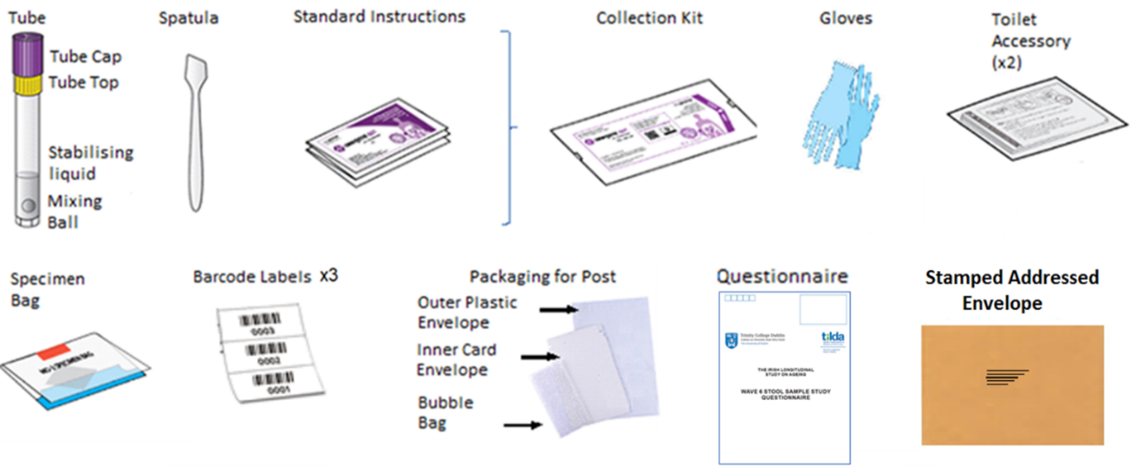
Equipment Description: The kit allows participants to safely and hygienically collect a stool sample in their own home. Barcode labels link the sample, questionnaire, and packaging to the participant ID to ensure accurate tracking. The questionnaire records dietary intake, and relevant details of the sample e.g time of sample collection.
Assessment Type: Centre or Home Assessment
Protocol
- Participants are guided by a health practitioners or nurse on how to use the kit, including reading the instructions carefully, attaching the barcode labels, and using the toilet accessory to collect the sample.
- Health practitioners record consent and kit distribution.
- The participant collects the stool at home in their own time.
- Once collected, the sample is placed in the tube, the questionnaire is completed, and both are packaged for return by post, ideally on the same day.
- Samples are logged and stored for later microbiome analysis.
Collection Waves
| Measure | Wave 1 | Wave 2 | Wave 3 | Wave 4 | Wave 5 | Wave 6 |
|---|---|---|---|---|---|---|
| Stool Sample | X |
Overview
Measuring: The seroprevalence rates of SARS-CoV-2 among participants, by measuring SARS-CoV-2 antibodies in saliva samples. This was used to explore demographic, clinical and biological factors associated with COVID-19 disease trajectory in the TILDA cohort.
Equipment used: Oracol+ saliva collection device
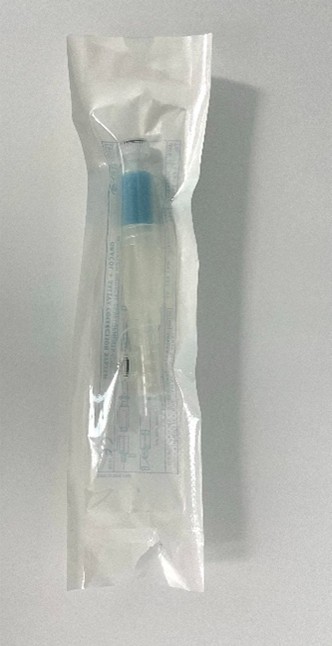
Equipment Description: The sponge swab, used similarly to a toothbrush, collects saliva by firmly rubbing along the gumline, extracting both saliva and gingival crevicular fluid (GCF, rich in Immunoglobulin G (IgG)). The swab is placed back into its container after collection.
Assessment Type: Centre or Home Assessment
Protocol
- Saliva sample kits were posted out to all active participants.
- An instruction guide for how to collect the sample was provided.
- Before taking the sample, the participants are asked to read the study information leaflet, complete the consent form and questionnaire, and wait at least 1 hour after eating or drinking to collect their saliva sample.
- They were also asked to take the sample between Monday and Thursday (not Friday or the weekend), for postal reasons.
Steps to take the saliva sample 1. Open the plastic pouch containing the swab 2. Unscrew the tube, separating at the mid-point. The tube will divide into two parts. Remove the swab from its container using the handle. Keep all the parts as you willneed to put the swab back into this container later. 3. Rub the swab along your gums for 1 - 2 minutes. This is like brushing your teeth but rubbing your gums instead. 4. Put the swab back into the part of the tube with the long narrow end. 5. From the other part of the tube, unscrew the small cap. 6. Place this part of the tube back onto the container over the swab handle. 7. Snap off the stick – this should easily snap off with a small bit of pressure. 8. Re-attach the screw cap. 9. Place the saliva collection tube into the bubble wrap pouch and seal pouch. 10. Put this pouch containing your sample, along with your completed consent form and questionnaire into the pre-paid envelope and post back to TILDA.
- Following collection of the saliva sample, participants are asked to put the completed and signed informed consent form, the completed questionnaire, their saliva sample within the bubble wrap pouch in the pre-paid envelope and post it back to TILDA within 24 hours of taking their sample.
Collection Waves
| Measure | Wave 1 | Wave 2 | Wave 3 | Wave 4 | Wave 5 | Wave 6 |
|---|---|---|---|---|---|---|
| Saliva Sample | X |