Health Assessment - Neuropsychological
Neuropsychological
TThe neuropsychological domain in TILDA comprises a range of standardised assessments designed to evaluate cognitive function in older adults. Measures collected across waves assess domains including memory, attention, executive function, processing speed, verbal fluency, and global cognitive function.
Neuropsychological Measures
Click each heading to expand details of this test.
Overview
Measuring: Screening tool for clinically relevant depression symptoms. Depressive symptomology influences cognition and it is important to control for mood when analysing cognitive results
Equipment used: CESD-8 Scale. Responses are recorded electronically by the assigned health practicioner.
Assessment Type: Centre or Home Assessment
Protocol
- The health practicioner reads a set of eight statements to the participant assessing mood, feelings and well-being.
- The participant is asked to respond from a set of four defined responses regarding how they felt that way or behaved in the past week.
- Responses are recorded electronically on the health assessment software following each statement response.
Collection Waves
| Measure | Wave 1 | Wave 2 | Wave 3 | Wave 4 | Wave 5 | Wave 6 |
|---|---|---|---|---|---|---|
| CESD8 | X | X | X |
Citation
- Radloff, L.S. (1977). The CES-D Scale: A Self-Report Depression Scale for Research in the General Population. Applied Psychological Measurement, 1(3): 385–401. https://doi.org/10.1177/014662167700100306 (Original Scale)
- Briggs, R., Carey, D., O’Halloran, A.M., Kenny, R.A. and Kennelly, S.P. (2018). Validation of the 8-item Centre for Epidemiological Studies Depression Scale in a cohort of community-dwelling older people: data from The Irish Longitudinal Study on Ageing (TILDA). European Geriatric Medicine, 9(5): 681–687. https://doi.org/10.1007/s41999-017-0016-0
Example TILDA Papers
- O’Halloran, A.M., Kenny, R.A. and King-Kallimanis, B.L. (2014). The latent factors of depression from the short forms of the CES-D are consistent, reliable and valid in community-living older adults. European Geriatric Medicine, 5(2): 97–102. https://doi.org/10.1016/j.eurger.2013.12.004
- Orr, J., Tobin, K., Carey, D., Kenny, R. A., & McGarrigle, C. (2019). Religious Attendance, Religious Importance, and the Pathways to Depressive Symptoms in Men and Women Aged 50 and Over Living in Ireland. Research on Aging, 41(9), 891-911. https://doi.org/10.1177/0164027519860270
- Ward M, Briggs R, McGarrigle CA, De Looze C, O’Halloran AM, Kenny RA. (2023), The bi-directional association between loneliness and depression among older adults from before to during the COVID-19 pandemic. Int J Geriatr Psychiatry, 38: 1-8. https://doi.org/10.1002/gps.5856
Overview
Measuring: Attention and speed of processing information in the brain.
Equipment used: Ergodex™ board, computer.
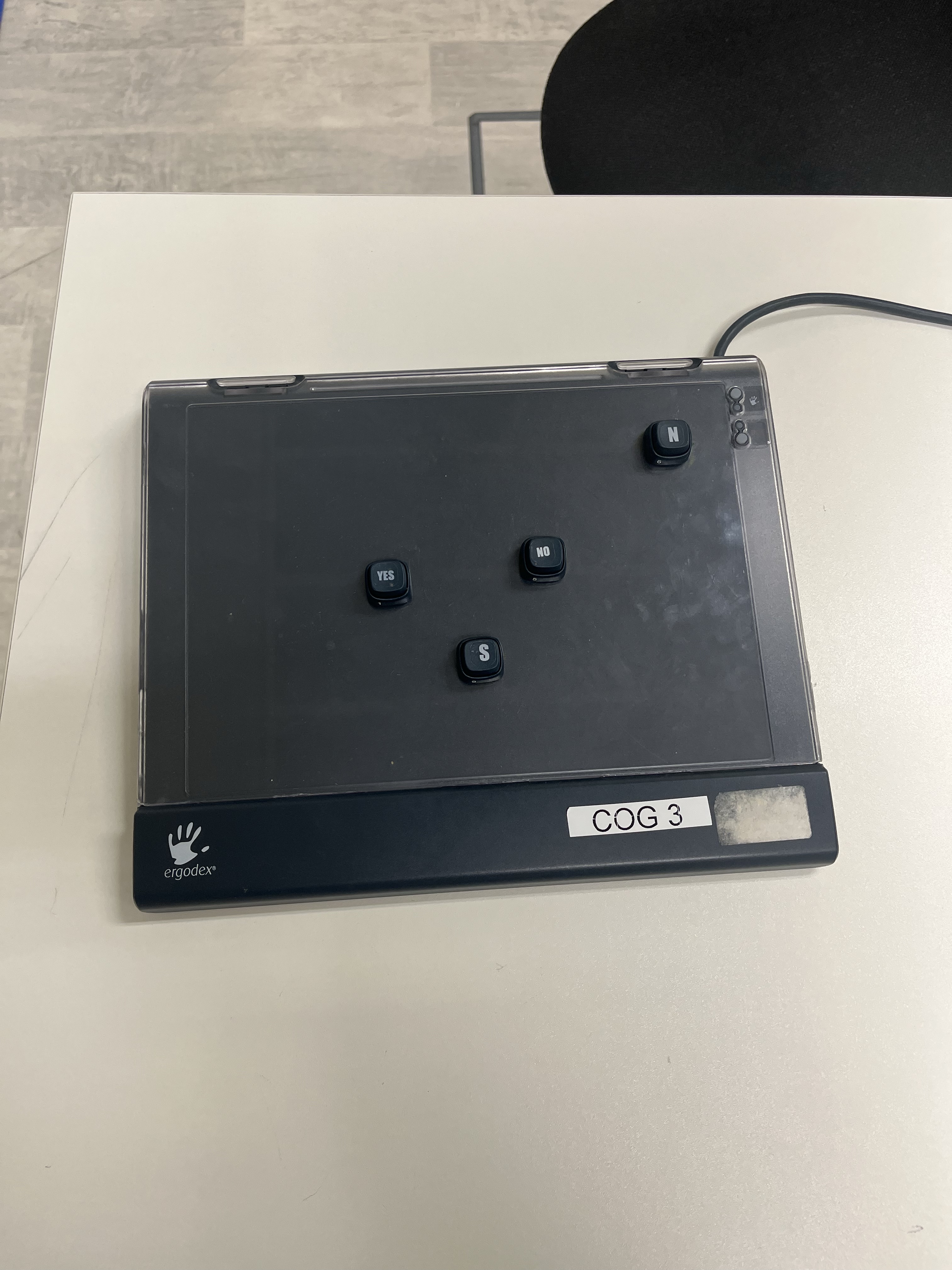
Equipment Description: The Ergodex board is a response panel containing buttons for Yes, No and a central button for participants to rest their finger on. It is connected to the laptop via USB. The Ergodex board and the laptop are placed on the table in front of the participant.
Assessment Type: Centre or Home Assessment
Protocol
- Participants are asked to hold down a central button until a stimulus appeared on the laptop screen; either the word YES or the word NO.
- Each time a stimulus appeared, respondents are asked to press the corresponding button.
- A return to the central button is necessary after each response for the next word to appear on-screen.
- There are approximately 100 repetitions.
Collection Waves
| Measure | Wave 1 | Wave 2 | Wave 3 | Wave 4 | Wave 5 | Wave 6 |
|---|---|---|---|---|---|---|
| CRT | X | X | X |
Choice Reaction Time Variables
| Variable label | TILDA Variable |
|---|---|
| Mean cognitive response time | CRTmeancog |
| Mean cognitive response time if target was yes | CRTmeancogyes |
| Mean cognitive response time if target was no | CRTmeancogno |
| Mean cognitive response time in first 50 responses | CRTmeancogfirst |
| Mean cognitive response time in second 50 responses | CRTmeancogsecond |
| Mean motor response time | CRTmeanmot |
| Mean motor response time if target was yes | CRTmeanmotyes |
| Mean motor response time if target was no | CRTmeanmotno |
| Mean motor response time in first 50 responses | CRTmeanmotfirst |
| Mean motor response time in second 50 responses | CRTmeanmotsecond |
| Mean total response time | CRTmeantot |
| Mean total response time if target was yes | CRTmeantotyes |
| Mean total response time if target was no | CRTmeantotno |
| Mean total response time in first 50 responses | CRTmeantotfirst |
| Mean total response time in second 50 responses | CRTmeantotsecond |
| SD of cognitive response time | CRTsdcog |
| SD of cognitive response time if target was yes | CRTsdcogyes |
| SD of cognitive response time if target was no | CRTsdcogno |
| SD of cognitive response time in first 50 responses | CRTsdcogfirst |
| SD of cognitive response time in second 50 responses | CRTsdcogsecond |
| SD of motor response time | CRTsdmot |
| SD of motor response time if target was yes | CRTsdmotyes |
| SD of motor response time if target was no | CRTsdmotno |
| SD of motor response time in first 50 responses | CRTsdmotfirst |
| SD of motor response time in second 50 responses | CRTsdmotsecond |
| SD of total response time | CRTsdtot |
| SD of total response time if target was yes | CRTsdtotyes |
| SD of total response time if target was no | CRTsdtotno |
| SD of total response time in first 50 responses | CRTsdtotfirst |
| SD of total response time in second 50 responses | CRTsdtotsecond |
| Number of correct choices | CRTcorrect |
| Sum of cognitive outliers | CRTcogoutliers |
| Sum of motor outliers | CRTmotoutliers |
| Number of faulty trials dropped | CRTfaulty |
| Number of valid trials | CRTtrials |
Citation
- Smith, E. E. (1968). Choice reaction time: An analysis of the major theoretical positions. Psychological Bulletin, 69(2), 77–110. https://doi.org/10.1037/h0020189
Example TILDA Papers
- Chintapalli, R., & Romero-Ortuno, R. (2021). Choice reaction time and subsequent mobility decline: Prospective observational findings from The Irish Longitudinal Study on Ageing (TILDA). EClinicalMedicine, 31.
- Frewen, J., Savva, G. M., Boyle, G., Finucane, C., & Kenny, R. A. (2014). Cognitive performance in orthostatic hypotension: findings from a nationally representative sample. Journal of the American Geriatrics Society, 62(1), 117–122. https://doi.org/10.1111/jgs.12592
Overview
Measuring: Visual scanning and executive function.
Equipment used: Colour trials 1 & colour trails 2 booklet, stopwatch, pencil
Assessment Type: Centre or Home Assessment
Protocol
- For the Colour Trails 1 test, the participant is instructed to rapidly draw a line connecting the circles numbered 1 through 25 in consecutive order.
- The participant completes a practice trial prior to proceeding with the actual Colour Trails 1 trial. The participant is told to perform the task as quickly as possible without making errors.
- The research nurse records the length of time (in seconds) required by the participant to complete the Colour Trails 1 test trial.
- The research nurse also records the number of near-misses, errors and prompts. For the Colour Trails 2 trial, the research nurse instructs the participant to rapidly draw a line between numbered circles, maintaining the sequence of numbers, but alternating between pink and yellow colours.
- The participant completes an additional practice trial prior to proceeding with the Colour Trails 2 trial.
- The research nurse records the length of time required to complete the test trial along with the number of near-misses, prompts, colour sequence errors and number sequence errors made by the participant.
Collection Waves
| Measure | Wave 1 | Wave 2 | Wave 3 | Wave 4 | Wave 5 | Wave 6 |
|---|---|---|---|---|---|---|
| Colour Trails Test | X | X | X |
Scoring
Scoring: Time taken to complete each part of the Colour Time Trails is recorded in seconds. The number of prompts, near misses and errors are counted for each Colour Time Trial.
Citation
- Tyburski, E., Karabanowicz, E., Mak, M., Lebiecka, Z., Samochowiec, A., Pełka-Wysiecka, J., Sagan, L., & Samochowiec, J. (2020). Color Trails Test: A New Set of Data on Cognitive Flexibility and Processing Speed in Schizophrenia. Frontiers in psychiatry, 11, 521. https://doi.org/10.3389/fpsyt.2020.00521
Example TILDA Papers
- Feeney, J., Savva, G. M., O’Regan, C., King-Kallimanis, B., Cronin, H., & Kenny, R. A. (2016). Measurement Error, Reliability, and Minimum Detectable Change in the Mini-Mental State Examination, Montreal Cognitive Assessment, and Color Trails Test among Community Living Middle-Aged and Older Adults. Journal of Alzheimer’s disease : JAD, 53(3), 1107–1114. https://doi.org/10.3233/JAD-160248.
Overview
Measuring: Global Cognitive Status.
Equipment used: Cognitive booklet, wristwatch, pencil, laptop.
Equipment Description: Research nurse carries out the test by reading instructions directly from the laptop screen and recording answers in cognitive booklet. Participant uses the cognitive booklet to complete the written sections.
Assessment Type: Centre or Home Assessment
Protocol
- The assessment is conducted in a quiet, distraction free environment.
- Research nurse provides a polite and friendly introduction to the participant and asks, “May I ask you some questions about your memory?”
- Research nurse reassures participant, “These are routine questions that I have to ask everybody”.
- The research nurse proceeds through the full MMSE examination, recording answers electronically.
Collection Waves
| Measure | Wave 1 | Wave 2 | Wave 3 | Wave 4 | Wave 5 | Wave 6 |
|---|---|---|---|---|---|---|
| MMSE | X | X | X | X | X | X |
* MMSE is also administered in the home during the Face to Face interviews from Wave 2 onwards*
Citation
- Folstein, M. F., Folstein, S. E., & McHugh, P. R. (1975). “Mini-mental state”: A practical method for grading the cognitive state of patients for the clinician. Journal of Psychiatric Research, 12(3), 189–198.
Example TILDA Papers
- Costello, N., Symonds, J. E., Rooney, B., & Santos, F. H. (2026). Hidden trajectories and cognitive impairment risk: the use of latent change score models to assess the processing speed theory of cognitive ageing. Aging & Mental Health, 1-11.
- Ryan, D. J., De Looze, C., McGarrigle, C. A., Scarlett, S., & Kenny, R. A. (2024). Examining mental health and autonomic function as putative mediators of the relationship between sleep and trajectories of cognitive function: findings from the Irish longitudinal study on ageing (TILDA). Aging & Mental Health, 28(12), 1634-1641.
- Cominetti, M. R., Pott, H., Zúñiga, R. G., & Romero-Ortuno, R. (2023). Protecting cognitive function in older adults with age-related hearing loss: Insights from The Irish Longitudinal Study on Ageing (TILDA) and the role of hearing aids. Archives of Gerontology and Geriatrics, 112, 105043.
- Donnell, D. O., Romero-Ortuno, R., Kennelly, S. P., O’Neill, D., Donoghue, P. O., Lavan, A., Cunningham, C., McElwaine, P., Kenny, RA., & Briggs, R. (2023). The ’Bermuda Triangle’of orthostatic hypotension, cognitive impairment and reduced mobility: prospective associations with falls and fractures in The Irish Longitudinal Study on Ageing. Age and ageing, 52(2), afad005.
Overview
Measuring: Tool for early detection of mild cognitive impairment. It assesses different cognitive domains: attention and concentration, executive functions, memory, language, visuoconstructional skills, conceptual thinking, calculations, and orientation.
Equipment used: MoCA assessment sheet, clipboard, stopwatch, pencil.
Equipment Description: Research nurse holds the MoCA assessment sheet on a clipboard during the assessment. The stopwatch is used Language section of the assessment.
Assessment Type: Centre or Home Assessment
Protocol
- The assessment is conducted in a quiet, distraction free environment. It takes about 10 minutes to complete.
- Participants are asked to ‘Please do your best’ in the assessment.
- Scores for each domain are calculated on the right side of the assessment page and summed by the research nurse.
- One additional point is added for a participant who has 12 years or fewer of formal education.
Collection Waves
| Measure | Wave 1 | Wave 2 | Wave 3 | Wave 4 | Wave 5 | Wave 6 |
|---|---|---|---|---|---|---|
| MoCA | X | X | X |
Citation
- Nasreddine, Z. S., Phillips, N. A., Bédirian, V., Charbonneau, S., Whitehead, V., Collin, I., Cummings, J. L., & Chertkow, H. (2005). The Montreal Cognitive Assessment, MoCA: A brief screening tool for mild cognitive impairment. Journal of the American Geriatrics Society, 53(4), 695-699.
Example TILDA Papers
- Kenny, R.A., Coen, R.F., Frewen, J., Donoghue, O.A., Cronin, H. and Savva, G.M. (2013). Normative values of cognitive and physical function in older adults: findings from the Irish Longitudinal Study on Ageing. Journal of the American Geriatrics Society, 61, pp.S279-S290.
- Coen, R.F., Robertson, D.A., Kenny, R.A. and King-Kallimanis, B.L. (2016). Strengths and limitations of the MoCA for assessing cognitive functioning: findings from a large representative sample of Irish older adults. Journal of geriatric psychiatry and neurology, 29(1), pp.18-24.
- May, P., De Looze, C., Feeney, J., Matthews, S., Kenny, R.A. and Normand, C. (2022). Do Mini–Mental State Examination and Montreal Cognitive Assessment predict high‐cost health care users? A competing risks analysis in The Irish Longitudinal Study on Ageing. International Journal of Geriatric Psychiatry, 37(7).
- Cominetti, M.R., Pott-Junior, H., Cominetti, C., Zúñiga, R.G. and Romero-Ortuno, R. (2022). Type 2 diabetes mellitus predicts cognitive decline: Evidence from the Irish longitudinal study on ageing (TILDA). Diabetes Epidemiology and Management, 7, p.100087.
Overview
Measuring: Estimate of the participant’s pre-morbid intellectual ability (i.e. by pre-morbid we mean before any marked decline in cognitive function has taken place).
Equipment used: NART word cards, score sheet, pencil.
Equipment Description: NART word cards are placed in front of the participant by the research nurse. Score sheet is used by research nurse to score each word pronunciation.
Assessment Type: Centre or Home Assessment
Protocol
- Research nurse places NART word cards in front of participants and asks the participant to read each word on the card out loud.
- The test consists of 50 irregularly spelled words (i.e. they are not pronounced as they are written) and assumes that if the participant is familiar with the word, they will know that it has an irregular pronunciation.
- Participants are not timed in this task, however, if the participant takes longer than 10-15 seconds, the research nurse will move on to the next NART word card.
- When participant reads a word aloud, research nurse allows 3 seconds to elapse after the participant has read the word before progressing to the next word.
- If the respondent scores more than 5 words incorrect within the first 25 words, the test can be discontinued after 25 words.
- The participant may change a response if they wish to.
Collection Waves
| Measure | Wave 1 | Wave 2 | Wave 3 | Wave 4 | Wave 5 | Wave 6 |
|---|---|---|---|---|---|---|
| NART | X |
Citation
- Nelson HE (1982), National Adult Reading Test (NART): For the Assessment of Premorbid Intelligence in Patients with Dementia: Test Manual, NFER-Nelson, Windsor, UK.
- Blair, J. R., & Spreen, O. (1989). Predicting premorbid IQ: A revision of the national adult reading test. Clinical Neuropsychologist, 3(2), 129–136. https://doi.org/10.1080/13854048908403285
Example TILDA Papers
- Boyle, R., Knight, S., de Looze, C., Carey, D., Stern, Y., Robertson, I. H., Kenny, R. A., & Whelan, R. (2021). Verbal intelligence is a more robust cross-sectional measure of cognitive reserve than level of education in healthy older adults. Alzheimer’s Research & Therapy, 13(1), 121.
- Mosca, I., & Wright, R. E. (2025). The Relationship Between Personality and Employment: Evidence From the Irish Marriage Bar. Bulletin of Economic Research, 77(3), 415-432.
- Maasakkers, C. M., Claassen, J. A. H. R., Scarlett, S., Thijssen, D. H. J., Kenny, R. A., Feeney, J., & Melis, R. J. F. (2021). Is there a bidirectional association between sedentary behaviour and cognitive decline in older adults? Findings from the Irish Longitudinal Study on Ageing. Preventive Medicine Reports, 23, 101433
Overview
Measuring: Visual memory.
Equipment used: Pictures – CAMDEX-R booklet.
Equipment Description: The schedule named the Cambridge Mental Disorders of the Elderly Examination (CAMDEX) includes a range of objective cognitive tests which constitute a minineuropsychological battery.
Assessment Type: Centre or Home Assessment
Protocol
- In the ‘acquisition’ section, participants are asked to name some objects shown to them in pictures.
- The participant is allowed 2 seconds to see each picture.
- Acceptable answers depended on local usage as some items may have more than one correct name.
- Descriptions of function or approximate answers are not acceptable. Participants are not forewarned that these objects need to be remembered later.
- At a later time during the assessment, the participant is asked to recall the objects in the pictures. Either descriptions or names are acceptable here. This is the ‘free recall’ section.
- Participants are then shown 6 sets of pictures in the assessment booklet and asked to identify which pictures they were shown previously. Each set of pictures contain three similar objects, only one of which appears earlier. This is the ‘recognition’ section.
Collection Waves
| Measure | Wave 1 | Wave 2 | Wave 3 | Wave 4 | Wave 5 | Wave 6 |
|---|---|---|---|---|---|---|
| Picture Memory Test | X |
Citation
- Roth, M., Tym, E., Mountjoy, C. Q., Huppert, F. A., Hendrie, H., Verma, S., & Goddard, R. (1986). CAMDEX: A Standardised Instrument for the Diagnosis of Mental Disorder in the Elderly with Special Reference to the Early Detection of Dementia. British Journal of Psychiatry, 149(6), 698–709. doi:10.1192/bjp.149.6.698
- Zonderman, A. B., Giambra, L. M., Arenberg, D., Resnick, S. M., Costa Jr, P. T., & Kawas, C. H. (1995). Changes in immediate visual memory predict cognitive impairment. Archives of Clinical Neuropsychology, 10(2), 111-123.
Example TILDA Papers
- Maguire, F. J., Killane, I., Creagh, A. P., Donoghue, O., Kenny, R. A., & Reilly, R. B. (2018). Baseline association of motoric cognitive risk syndrome with sustained attention, memory, and global cognition. Journal of the American Medical Directors Association, 19(1), 53-58.
- Donoghue, O. A., Horgan, N. F., Savva, G. M., Cronin, H., O’Regan, C., & Kenny, R. A. (2012). Association between timed up‐and‐go and memory, executive function, and processing speed. Journal of the American Geriatrics Society, 60(9), 1681-1686.
Overview
Measuring: Audio-visual perception.
Equipment used: Administered via dedicated software on a laptop.
Assessment Type: Centre or Home Assessment
Protocol
- The laptop is placed in front of the participant. The test begins with a fixation cross in the middle of the screen, followed by the target stimuli.
- For the first half of the test a random order of multisensory illusory trials, non-illusory trials and unisensory visual trials, are presented to the participant twice.
- The participant reports the number of perceived visual flashes to the research nurse.
- The research nurse will record this by pressing the corresponding digit on the separate keyboard.
- For the 2nd half of the test unisensory auditory trials are presented to the participant and the participant reports the number of perceived auditory beeps to the research nurse.
- The research nurse will record this by pressing the corresponding digit on the separate keyboard.
- It is emphasised to the participant that they need to look at the fixation cross at all times during the test
Collection Waves
| Measure | Wave 1 | Wave 2 | Wave 3 | Wave 4 | Wave 5 | Wave 6 |
|---|---|---|---|---|---|---|
| SIFI | X |
Citation
- Shams L, Kamitani Y, Shimojo S (2002) Visual illusion induced by sound. Cog Brain Res 14:147–152. https://doi.org/10.1016/S0926-6410(02)00069-1
Example TILDA Papers
- O’Dowd, A., Hirst, R. J., Setti, A., Kenny, R. A., & Newell, F. N. (2023). Older adults with slow sit to stand times show reduced temporal precision of audio–visual integration. Experimental Brain Research, 241(6), 1633-1642.
Overview
Measuring: Sustained attention - the ability to direct and focus cognitive activity on specific stimuli.
Equipment used: Laptop and Presentation version 16.5 software.
Equipment description: Dell Latitude E6400 with Intel Core 2 Duo CPU, 2 Gb RAM, using Windows 7 Professional OS, 60 Hz refresh rate. Presentation version 16.5, by Neurobehavioral Systems, is a legacy Windows-based stimulus delivery and experimental control software.
Assessment Type: Centre or Home Assessment
Protocol
- Respondents are asked if they have epilepsy before beginning the test. If yes, the research nurse informs the participant that “While this test does not contain strobe lighting, there is a small chance that the lights may induce an epileptic seizure. Are you happy to proceed?”
- If respondents are not happy to proceed, the research nurse records the participant as ‘unwilling’ to proceed with the test in the centre software and moves onto the next test
- The laptop is placed in front of the participant. The respondent is allowed to practice until the research nurse feels that they understand the instructions.
- During the test, Participants are required to respond to a repeating stream of consecutive digits 1 to 9 (GO trials) but withhold responding to the digit 3 (NO–GO trials).
- The size of the numbers vary throughout the test. The numbers will appear on the screen above a fixation cross, which the participant is asked to focus on during the test.
- The participant is asked to click the ‘YES’ button (space bar) every time they see a number except for number 3.
- The respondent presses the ‘YES’ button on the laptop to begin the test.
- The command ‘Press YES Key for Each Number Except for Number 3’ appears on the screen.
- The research nurse reminds the respondent to look at the fixation cross throughout the test.
Collection Waves
| Measure | Wave 1 | Wave 2 | Wave 3 | Wave 4 | Wave 5 | Wave 6 |
|---|---|---|---|---|---|---|
| SART | X | X | X |
Citation
- Robertson, I. H., Manly, T., Andrade, J., Baddeley, B. T., & Yiend, J. (1997). Oops!’: performance correlates of everyday attentional failures in traumatic brain injured and normal subjects. Neuropsychologia, 35(6), 747-758.
Example TILDA Papers
- O’Halloran, A. M., Finucane, C., Savva, G. M., Robertson, I. H., & Kenny, R. A. (2014). Sustained attention and frailty in the older adult population. The journals of gerontology. Series B, Psychological sciences and social sciences, 69(2), 147–156. https://doi.org/10.1093/geronb/gbt009
- Rizzo, R., Knight, S. P., Davis, J. R. C., Newman, L., Duggan, E., Kenny, R. A., & Romero-Ortuno, R. (2021). SART and Individual Trial Mistake Thresholds: Predictive Model for Mobility Decline. Geriatrics (Basel, Switzerland), 6(3), 85. https://doi.org/10.3390/geriatrics6030085
- Knight, S. P., Ward, M., Duggan, E., Xue, F., Kenny, R. A., & Romero-Ortuno, R. (2023). Evaluation of a 3-Item Health Index in Predicting Mortality Risk: A 12-Year Follow-Up Study. Diagnostics (Basel, Switzerland), 13(17), 2801. https://doi.org/10.3390/diagnostics13172801
Overview
Measuring: Executive Function.
Equipment used: CAMDEX-R booklet.
Equipment Description: The schedule named the Cambridge Mental Disorders of the Elderly Examination (CAMDEX) includes a range of objective cognitive tests which constitute a minineuropsychological battery.
Assessment Type: Centre or Home Assessment
Protocol
- The research nurse places card 1 of the Reasoning Test in the CAMDEX booklet and in front of the participant.
- The participant is asked to identify which object should be placed in an empty space in a pre-prescribed sequence of objects.
- If the participant makes a mistake on the first sequence, the research nurse identifies the correct option and explains why it is correct.
- The research nurse then places the next sequence of the Reasoning Test on card 2 in the CAMDEX booklet and in front of the participant.
- The same protocol described above applies.
- Following Card 1 and Card 2, no further corrections are provided to the participant.
- The research nurse continues onto cards 3-6.
- If the participant requests further clarification, the research nurse returns to card 1 and/or 2 and explains these again.
Collection Waves
| Measure | Wave 1 | Wave 2 | Wave 3 | Wave 4 | Wave 5 | Wave 6 |
|---|---|---|---|---|---|---|
| Visual Reasoning Test | X |
Citation
- Roth, M., Tym, E., Mountjoy, C. Q., Huppert, F. A., Hendrie, H., Verma, S., & Goddard, R. (1986). CAMDEX: A Standardised Instrument for the Diagnosis of Mental Disorder in the Elderly with Special Reference to the Early Detection of Dementia. British Journal of Psychiatry, 149(6), 698–709. doi:10.1192/bjp.149.6.698