Health Assessment - Accelerometry
Accelerometry
The accelerometry domain in TILDA comprises objective measures of habitual sleep, physical activity and movement behaviour, collected using wearable accelerometer devices. These data provide detailed information on sleep duration, efficiency, disruption, physical activity intensity, duration, frequency, sedentary behaviour, and daily movement patterns under free-living conditions. Accelerometry supports research into healthy ageing, physical function, frailty, mobility, sleep, cardiovascular and metabolic health, cognitive ageing, mental health, falls, disability, and broader health outcomes.
Accelerometry Measures
Click each heading to expand details of this test.
Overview
Measuring: Wrist-worn actigraphy measures physical activity, movement patterns, and sleep-wake cycles using accelerometery. Participants wear a GENEActiv device on their wrist, which continuously records movement data over a 7-day period. This allows assessment of daily activity, sleep duration, circadian rhythm, and overall activity levels. Accelerometery data was collected as part of the Health Assessment at Wave 3 and Wave 6.
Equipment used: GENEActiv Wrist-Worn Accelerometer (MEMS 3-axis accelerometer; ±8g; 100Hz)
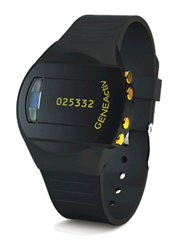
Equipment Description: The accelerometer is waterproof, records three-axis movement at 100Hz, and includes a body temperature sensor to confirm wear. The charging cradle recharges the device and allows data download and configuration.
Assessment Type: Centre or Home Assessment
Protocol
- A limited number of devices were available - sampling method was opportunistic
- At the end of their health assessment, where a device was available the participant was offered it.
- Where a participant consented to wear the device, the health practicioner configures the accelerometer in the GENEActiv software with the participant’s TILDA ID.
- Device was set to record at 100Hz for seven days starting at 9pm on the data of assessment.
- Participants were instructed to wear the device continuously including during water activities.
- Participants wore the device on their non-dominant wrist where possible.
- After seven days, participants return the device in the protective packaging, and data is downloaded.
- Check the device for damage and fully charge it in the cradle for up to three hours.
Collection Waves
| Measure | Wave 1 | Wave 2 | Wave 3 | Wave 4 | Wave 5 | Wave 6 |
|---|---|---|---|---|---|---|
| Wrist-worn Actigraphy | X | X |
Example TILDA Papers
Scarlett S, Nolan H, Kenny RA, O’Connell MD. Objective Sleep Duration in Older Adults: Results From The Irish Longitudinal Study on Ageing. J Am Geriatr Soc. 2020 Jan;68(1):120-128. doi: 10.1111/jgs.16177. Epub 2019 Oct 3. PMID: 31579942.
Scarlett S, Nolan HN, Kenny RA, O’Connell MDL. Discrepancies in self-reported and actigraphy-based sleep duration are associated with self-reported insomnia symptoms in community-dwelling older adults. Sleep Health. 2021;7(1):83–92. doi:10.1016/j.sleh.2020.06.003